




Silverpush Partner Spotlight: Velma Agbodo, Performance Director at Mediahub
PUBLISH DATE: 21 August 2025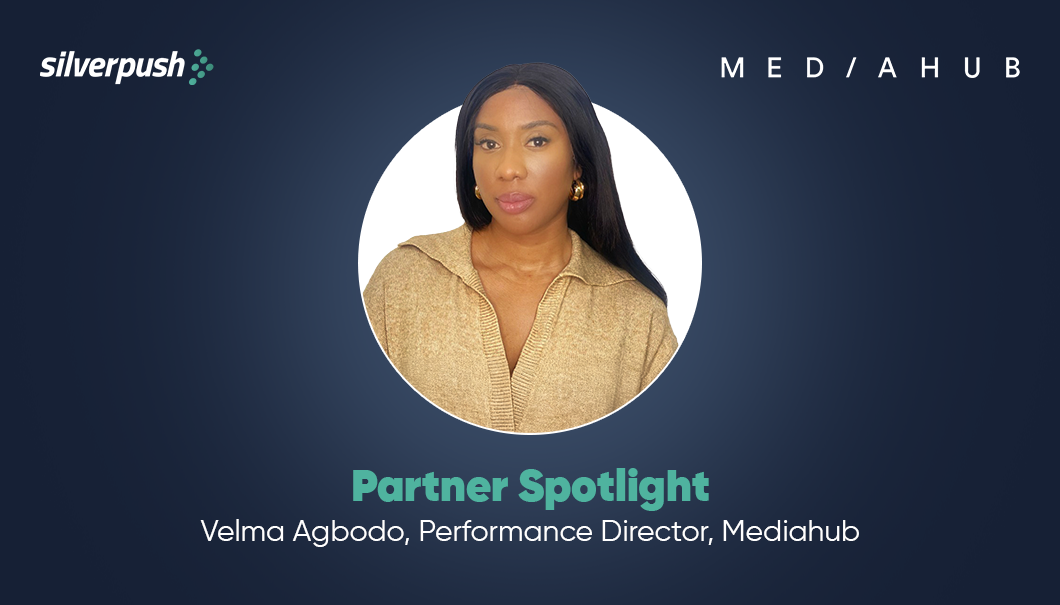
This week, we got the chance to talk with Velma Agbodo, the performance director at Mediahub UK. Velma talked to us about Mediahub, what sets the agency apart, and the big. changes in the market across AI, social media, and more. And the biggest motto from MediaHub: More Pilot, Less Auto.
1. Tell us about your agency. What makes you stand out?
Mediahub is part of IPG, and we stand out because we have a challenger mindset. We’re not satisfied with the status quo and consistently think outside the box. We fully commit to every campaign, empowering our team to deliver their best work. Ultimately, we focus on creating tailored solutions that align precisely with each client’s unique goals, not just following standards, but setting new ones.
This approach is rooted in our belief in More Pilot, Less Auto; we actively steer every campaign with strategic insight and human intelligence, rather than leaving success to chance or automation. At Mediahub, our precise, audience-focused approach enables us to pilot our campaigns, driving meaningful growth and breaking new ground.
2. What made you choose Silverpush as a contextual partner?
When evaluating vendors, Silverpush’s proprietary technology immediately stood out due to its unique ability to analyze video-level content—something truly different in the market. This innovation allows us to deliver more precise targeting and insights for our clients. Additionally, Silverpush is an efficient partner, enabling us to analyze video content quickly while driving significant cost efficiencies.
By partnering with Silverpush, we provide our clients with scalable reach combined with enhanced relevance and improved campaign efficiency, ultimately maximizing their return on investment.
3. Has the market changed recently? What are the biggest trends that you’ve seen with clients?
The market has definitely evolved recently, especially in how clients approach creative formats and content strategies. One of the biggest trends we’re seeing is the widespread adoption of vertical video formats. Shorts and reels have become a staple in the creative mix, allowing brands to engage audiences on platforms like TikTok, Instagram, and YouTube in a more native and immersive way.
Alongside this, influencer partnerships and native-style content are increasingly integral to campaigns. These approaches help brands connect authentically with their target audiences by blending seamlessly into the content consumers are already engaging with.
Another key trend is the rise of connected TV (CTV) as a premium digital channel, offering advertisers new ways to reach audiences with high-quality, engaging video content beyond traditional Linear TV.
Overall, these shifts reflect a move toward more agile, authentic, and targeted media strategies that drive stronger engagement and ROI for our clients.
4. What are some stand-out campaigns that you’ve run this year?
We executed a standout EMEA awareness campaign for a global toy company targeting kids. Our goal was to reach the exact audience of children to build awareness, boost purchase intent, and drive pester power. Using Silverpush’s technology, we were able to contextually target video-level content on YouTube, delivering ads alongside videos our core audience was actively engaging with.
Silverpush’s advanced tech allowed us to analyze for context and visual triggers within the video content, such as competitor branding, ensuring highly relevant ad placements. As a result, we achieved view completion rates (VCR) that exceeded benchmarks across all campaign segments and a positive lift in brand metrics, which we attribute to the strong audience resonance.
5. Have you noticed the impact of AI over the past year? Where have you seen it being used the most?
Yeah, definitely — AI has had a big impact over the past year, especially in media and marketing. One of the biggest things we’ve seen is how social platforms are using AI to automate many processes, like optimising how ads are delivered and who sees them. It’s not just about targeting anymore; the algorithms also help personalise creatives in real time, which makes campaigns a lot more effective.
On the creative side, AI tools are really helping to speed things up, whether it’s generating content, writing scripts, or making different versions for different audiences. Plus, there are media tools that use AI to track attention and behaviour, which gives us better insights to fine-tune campaigns.
That said, it’s still really important for marketers to pilot automation carefully and understand when and how to use it effectively, because the human touch is still key to making sure everything hits the mark.
So overall, AI is making campaigns smarter and more efficient, helping us get better results for clients without all the manual guesswork.
6. What are the biggest ad challenges and opportunities for brands?
One of the biggest challenges brands face today is ad creative. Producing the many iterations needed to ensure messaging resonates with different audiences and fits across various channels and formats can be time-consuming and resource-heavy. Scaling creative while maintaining quality and consistency remains a complex task.
Another challenge is navigating the rapidly changing digital landscape — with evolving privacy regulations and platform algorithm updates, targeting and measurement have become more complicated. Brands also struggle with fragmentation across channels, making it harder to deliver a seamless and coherent customer experience.
That said, there are huge opportunities as well. AI and automation are transforming how we approach creative optimisation, enabling faster iteration and personalisation at scale, which helps campaigns perform better. Data-driven insights give brands the ability to target more precisely and measure effectiveness more accurately than ever before.
Additionally, the rise of new formats like short-form vertical video and immersive experiences, combined with influencer and native content, opens fresh avenues for engagement. Brands that can innovate creatively while leveraging these tools and insights stand to gain a real competitive edge in connecting with audiences meaningfully.
How Brands Use Moment Marketing to Connect with Audiences
PUBLISH DATE: 18 August 2025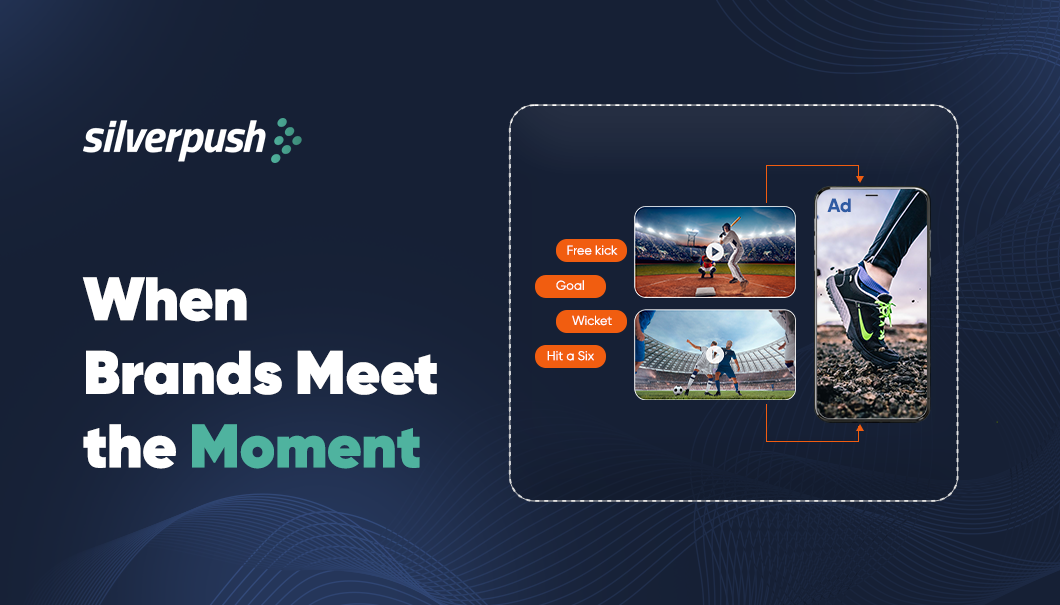
We’ve all been there. You’re scrolling through your feed, and suddenly you see a brand’s take on a trending meme, movie release, or cricket match moment. It’s quick, clever, and somehow, it feels like they read the room just right. That’s not luck. That’s moment marketing.
Over the past few years, moment marketing has moved from being a fun side tactic to something many brands actively build into their strategy. With attention spans shrinking to less than 8 seconds and audiences constantly jumping between screens, being present in the “now” matters more than ever. And the brands that get this are the ones that are starting conversations instead of just pushing campaigns.
Let’s dig into what makes moment-based marketing tick and why it’s working so well.
What is Moment Marketing?
Moment marketing, or real-time marketing, is when a brand rides the wave of what’s trending right now. It could be a news story, a pop culture reference, a weather update, or even a meme that’s blowing up. The idea is to connect your brand with the mood or moment your audience is already tuned into.
What makes it so effective is timing. When you drop a relevant message at just the right moment, it feels less like advertising and more like you’re part of the conversation. People are more likely to engage, share, and remember what you said.
You’ve probably seen brands like Zomato, Netflix India, Burger King, or Amul do this regularly. Whether it’s a tweet after a cricket win or a cheeky visual during a film release, they’ve mastered the art of showing up when the audience is most attentive and most active.
Why More Brands Are Leaning Into It
First, it doesn’t cost a fortune. You don’t need a big production budget to create a tweet or a static creative. What you need is speed, creativity, and timing. That’s a win in today’s cluttered media landscape.
Second, it makes your brand feel real. When people see you engaging with topics they care about right now, it adds personality and relevance. It also shows that your brand is listening, not just broadcasting.
And lastly, it’s a great way to cut through the noise. When something’s trending, people are already paying attention. If your message fits in naturally, you don’t have to fight as hard to be seen.
Making Moment Marketing Work for You
It starts with keeping your ears and eyes open. That means listening to what your audience is talking about, tracking social media trends, and following news cycles that matter to your industry or region.
But it’s not just about reacting to every single trend. You need to know which ones make sense for your brand. A good filter here is asking, “Can we say something meaningful or fun about this without sounding forced?”
Adding a touch of humor helps, but it needs to align with your brand tone. Zomato, for example, brings food into almost every trend they taps into. It’s fun, but it’s still on-brand.
You also want to be careful. Not every moment is meant to be jumped on. Topics around politics, religion, or crises often backfire if handled without context or sensitivity. If in doubt, it’s okay to skip it.
Now Here’s Where It Gets Tricky
While your team might be quick to create a tweet or a reel, your audience isn’t always sitting on one screen. In fact, a study by Think with Google shows that nearly 80% of people use a second screen (like their phone or tablet) while watching TV. Which means, even if you’re running a big TV campaign, you’re probably losing a chunk of attention during ad breaks.
That’s a real challenge. Because what’s the point of a smart, timely campaign if your audience is busy scrolling Instagram while your ad plays?
This is where it helps to think beyond just social posts and tweets. Real moment based marketing happens across screens and, ideally, at the same time. When your brand message shows up at the right moment—on the screen your audience is actually looking at—it doesn’t just get seen. It gets remembered.
How Parallels by Silverpush Changes the Game
If you’re thinking, “How do I even pull that off?” — that’s where platforms like Parallels by Silverpush come in.
Parallels is a real-time moment marketing platform that’s built exactly for this challenge. It detects live moments—like a six being hit during a cricket match, a sudden weather change, or even a trending event—and syncs your digital ad across mobile, CTV, laptop, or tablet right when it matters.

So, let’s say your TV ad runs during a sports break. Parallels picks up on that and instantly displays a contextual ad on your audience’s second screen, based on their interests or location. That could be a sports drink ad during a live match, a skincare product during a pollution alert, or a fashion brand during fashion week.
It’s real-time. It’s cross-device. And it’s driven by AI, so you don’t have to manually chase trends or trigger ads yourself.
[Case Study] How Lucky Me! Captured Rainy Day Moments Using Parallels Weather Sync
Lucky Me!, the Philippines’ leading instant noodle brand, wanted to connect with consumers during the rainy season when cravings for hot, comforting food are at their peak. The challenge was that traditional ads could not react to live weather changes, making it hard to reach people at the right moment.
Using Silverpush’s Parallels Weather Sync, ads were instantly triggered across Meta, TikTok, and OpenWeb whenever rainfall was detected in key regions. This real-time targeting delivered 13.1M impressions, 9.1M video views, a 3.4-point lift in ad recall on Meta, and exceptional VTR gains across all platforms. The campaign proved how aligning media delivery with real-world moments can drive powerful consumer engagement.
Why This Matters for Modern Marketers
If you’re in e-commerce, retail, or media, you already know that attention is fragmented. You can’t rely on one channel to do all the work. Moment marketing with a second-screen strategy gives you that extra edge. It helps you show up not just at the right moment but also on the right screen.
And the best part? It’s not about throwing your logo everywhere. It’s about being part of the experience your audience is already having. That’s what builds trust, engagement, and over time, brand love.
Final Thoughts
Moment marketing isn’t just a trend. It’s how people are experiencing the internet today—in real time, across platforms, while juggling multiple screens.
If your brand can tap into those moments with relevance and speed, you’re not just doing marketing. You’re joining conversations, shaping culture, and building connections that last.
And with a solution like Parallels, you don’t have to just hope your audience sees your message. You’ll know it’s showing up right where and when it counts.
Silverpush Partner Spotlight: Darren Hardeman, VP, Strategy, Media & AI, at PUSH
PUBLISH DATE: 23 July 2025
This week, the Silverpush team got a chance to talk with Darren Hardeman, the VP of Strategy, Media & AI, for Canada’s PUSH. PUSH is an indie agency that focuses on connecting media and creative in a new way, driving better results for each campaign and getting the most out of every touchpoint for clients. Darren shared his thoughts about context, the changes in the market, and how brands are successful. Read the full Silverpush Partner Spotlight Q&A below:
1. Tell us about your agency. What makes you stand out?
PUSH started from an idea that ‘wouldn’t everything work better if media and creative were always intertwined?’ So we built an agency model uniting media and creative from the very beginning, ensuring that every campaign message is conceived with purpose, delivered with impact, and measured to maximize outcomes. Feedback loops are built into the process, so all insights, both creative and media, are actioned immediately, maximizing performance today and in the future.
We make it simple and the way it should be: results-oriented, client-focused, and not agency-led or agenda-led.
2. What made you choose Silverpush as a contextual partner?
Anyone can find demographics, geo-targeting, or contextual targeting. Our advertiser partners need more hyper-personalized and addressable targeting. For example, we developed a strategy that used the Silverpush Mirrors product to scan videos to identify signals around the specific themes, brand safety, verifiable behaviors, and semantics of specific niche audiences.
For example, young adults are interested in STEM-related activities. By using Silverpush, we were able to find those specific audiences and align with contextual ad placements at scale. This partnership drove results that showed an increase in engagement and conversion rates because the quality of the audience was at a higher level than previous targeting methods.
3. Has the market changed recently? What are the biggest trends that you’ve seen with clients recently?
We are in a revolutionary period of change in marketing. In the Canadian market, we’re seeing:
- Less easily available data through more informed and skeptical consumers, as well as government regulations.
- More opportunities with increased media fragmentation across platforms.
- A dramatic increase in AI in every aspect of our work, with a different adoption rate depending on each client. Some accept AI-generated work. Others believe in a ‘wait and see when it improves’ approach.
4. What are some stand-out campaigns that you’ve run this year? What made them work?
I would say there are three things that make a campaign stand out:
- Being insight-led in the strategy and data-driven throughout your approach. By addressing objectives through insights about your audiences and using data to meet audiences where they are, we can create better, more meaningful connections for brands.
- Be omnichannel in your selection and approach. Plan and execute across all channels in a connected manner, as that is how our audience(s) will consume them.
- Be relevant in your placements and messaging. By being relevant, your audience will be more apt to relate, engage, recall, and/or respond.
We have used these principles to develop campaigns for our clients. One that comes to mind is a recent campaign for Humber where we developed a full funnel campaign that started with a video-neutral approach to drive awareness among direct and indirect student prospects through TV, CTV, OLV, and Social Video.
Surrounding all key audiences in Transit and DOOH. Then retargeting through display, social, and search channels to drive conversions. Each asset was relevant to the intended audience segment to increase the ad recall, engagement, and ultimately applications (the client’s business KPI).
5. Have you noticed the impact of AI over the past year? Where have you seen it being used the most?
Noticed it – yep, we use it every day. At PUSH, we use AI in almost every aspect of the process.
In media, it is in our advanced analytics like predictive modeling/MMM, our planning process, our buy optimizers (cross channel and within platforms), reporting, and insight generation.
For creativity, we can use it in our video, image, and text generation, allowing us to efficiently address ad fatigue and personalization.
Is it all 100% in all aspects? No, but every time we use it, it does get better.
6. What are the biggest ad challenges for brands? What are the biggest opportunities?
Here are four challenges that we hear from brands:
- ID Signal loss and privacy regulations/restrictions. This leads to complexity and increased tech cost due to needing additional solutions like data clean rooms.
- Overdependence on Walled Gardens. Too much emphasis on advertising on walled gardens drives prices up over time and leads to less transparency and competition in the long term.
- ROI pressure in a Fragmented Landscape. CMOs have to prove their investment is driving incrementality, which means there is more pressure on measurement than ever before.
- Standing out in a Saturated Market. Consumers are ignoring, blocking, and skipping ads. Brands are often wondering: ‘How can we stand out, get noticed, and be memorable?’
The first three challenges are easier to address: brands should increase their tech stack (when appropriate to drive incrementality and value), diversify spend, and implement advanced analytics like media mix modeling. The latter requires creativity, data-driven insights, and an experienced team that really wants to work alongside a marketer as a true partner.
7. What is your advertising hot take?
The world is full of uncertainty, and advertising is no different. But there are always opportunities in uncertain times, because it changes the way people usually respond to current situations. For example, during these uncertain economic times, marketers may see a down market and pull back investment. However, by taking this as an opportunity to invest and grow our share, we will come out ahead in the long term.
Uncertainty also forces us to continuously look for new opportunities and new partners to do more with less – and, of course, new opportunities to be more creative to gain attention, engagement, and conversions.
3 Takeaways from Cannes 2025: From Performance to Relevance
PUBLISH DATE: 01 July 2025
Last month, Silverpush team kicked off the #SummerOfContext in a big way at the Cannes Lions International Festival of Creativity 2025. To start off the week, we launched a brand new contextual targeting solution for TikTok to help brands with brand safety and higher relevance. We also announced our continued expansion into Europe, where Silverpush is growing more than 200% year-over-year and now operates out of seven different countries.
At Cannes, the Silverpush team met with agencies, brands, platforms, and partners to plan for the future of context together. We believe that, in a fragmented attention economy, context is everything – and, with contextual intelligence, advertisers can save money, get higher engagement, and drive better results.
There was a lot to unpack across Cannes, but one thing stood out: with a collaboration-first ecosystem, increasing automation, and advanced attribution, there is a new layer of efficiency and creativity unfolding. AI might just make advertising more human, after all – but we’ll see.
Here’s what the Silverpush team saw as the top three trends at Cannes 2025:-
1. The Era of Performance CTV is Here.
At a panel about CTV on the DoubleVerify yacht, Julie Triolo, SVP of Product Marketing at Fox, explained that convergence is key when thinking about understanding the current measurement maze.
With the right partners, advertisers can start to think about CTV as a full-funnel channel, tracking all the way down to performance. But that doesn’t happen without the right partners. As the CTV ecosystem matures, there’s a proliferation of inventory types like channels, apps, and operating systems that still make transparency difficult. Specific curation and contextual segments, according to the panel, can help with both measurement and targeting.
Want to read more about CTV+curation? Read about Silverpush Pre-Bid CTV Segments.
2. Relevance = Results.
At Cannes, the Silverpush team met up with a lot of brand leaders trying to navigate a fragmented media landscape. One brand leader in charge of a leading candy company explained that the company’s audience was literally “everyone with a mouth.”
After all, just about everyone might be interested in candy at some point in their life. But their individual context – at the moment – is what determines that they’ll be interested. Call it a seasonality of the mood. Especially if you have specific products for specific moments, like chocolate eggs during Easter. The more relevant your ad is to the audience’s current experience, the more likely they are to engage.
Kelly Williams, the Head of Commercial for ITV, said something similar. “About 95% of your audience is not in the market for what you are selling or advertising.”
The solution is relevance.
3. Branding is Making a Comeback.
Despite all the hope that everything that can be measured will be measured, there were also discussions about whether we might have reached the era of peak performance. For many companies, the brand has taken a backseat to the funnel. That might be changing.
“A lot of conversations at Cannes were about how so many marketers seem laser-focused on conversions, but their brands aren’t connecting with consumers,” Jeff Rich, SVP of Americas, says. “When brands take a myopic approach to transaction metrics, they tend to neglect the need for brand building and positioning. But I think the pendulum is swinging back and strategies are becoming better balanced.”
If branding is making a comeback, the other big conversation at Cannes was all about ad creative. As technology converges and allows companies to connect every dot, there’s a chance that the most important thing might become the story itself and telling it the right way, however your audience hears it.
The Silverpush team was thrilled to be on the ground last week to learn and work with everyone else in the industry and to celebrate the #SummerOfContext. Thank you to all the partners and clients who spent time with us last week, and we can’t wait to unveil what’s next for context!
Partner Spotlight: Ben Salaman, Senior Strategist at PB&
PUBLISH DATE: 17 June 2025
1. Tell us about your agency. What makes you stand out?
PB& is a small, independent agency that was founded by people who have spent a lot of their careers in larger agencies. We saw that creativity and efficiency often tend to suffer due to silos, so our founder decided to launch an agency built on a leaner model that would be led by “Thinkers” and “Makers.”
We have a deep bench of senior creatives who can tailor creatives to client and campaign needs. The same core team is on every client call, so we can stay aligned from start to finish, and our clients know what to expect. This allows us to work swiftly and keep things simple and straightforward for our clients. Our team lives and breathes by the ethos that simplicity is the ultimate form of sophistication.
2. What made you choose Silverpush as a contextual partner?
We got introduced to Silverpush, because YouTube is a tough nut to crack. When you traditionally target just by something like interests and demographics, you’re not reaching all the potential audiences who are most likely to be engaged. Considering the amount of content on the platform – low quality, independent, high quality, Shorts, long form, etc – we knew we needed a contextual solution to more precisely target YouTube videos. Silverpush helps us strategically connect with the best audiences in the right moments and gives us more confidence in the video content that we’re targeting and running creative in.
3. Has the market changed recently? What are the biggest trends that you’ve seen with clients recently?
It’s a tighter economy. Clients want to get to the bottom of the funnel quickly.
This is a continuous conversation in the industry now: brand building versus driving performance. But the conversation should always be about brand and performance. You’re not usually going to ask someone to marry you after the first date. That’s why brand building is still important, and building greater brand equity around fandom and community is crucial. The need for this has become even more pronounced, especially since our attention spans have become so fragmented. You still need affinity and emotional connection to resonate, get people to lean in further, and ultimately drive conversions.
Today at PB&, we often think about media mix not as a linear funnel, but as an always-on flywheel and how an ongoing content stream will continue delivering value over time. That’s what builds momentum for the brand and eventually drives more sales and loyalty overall.
4. What are some stand-out campaigns that you’ve run this year? What made them work? (*no need to name clients – more interested in tactics)
One in particular jumps to mind. The Seattle Kraken came to us after they got a less-than-ideal opener slot. When you’re kicking off a season, you generally want to be in a primetime slot. But, the Kraken got 1:30 pm on a Tuesday. So the team knew they needed to build hype to get people to watch the game and pack the arena.
In a market like Seattle, fans are scattered around the city with a tough commute. So the afternoon on a weekday isn’t ideal, especially for a home opener. Kids are in school, and parents are at work. We knew we had to add emotional weight to the game beyond just opening day, so we came up with the creative platform, “ Hooky for Hockey.” We ran media across channels owned and operated by Kraken, local news, social media, and more.
We saw the results on opening day: the arena was sold out, and fans came with signs proudly showing they were playing “Hooky for Hockey.” There was even ESPN coverage, where they mentioned Hooky For Hockey during the live broadcast. Making that campaign become part of the conversation in the hockey world was a big win for the Kraken and really set the tone for the season.
With Silverpush, we’ve focused on driving engagement from viewers for matches throughout the season. We know sports viewing behaviors have changed. Especially with younger demos consuming YouTube Shorts and Instagram Reels, it’s all about the highlights. By using Silverpush Mirrors, we can deliver our ads to specific hockey highlights with messaging that encourages people to tune in live, with campaigns like, “Why watch the highlights when you can see it live?”
5. Have you noticed the impact of AI over the past year? Where have you seen it being used the most?
I think a tidal wave is incoming and people are in for a rude awakening in our industry, not just creative, but across the board. We’re seeing it used in many pockets all around the industry, especially with D2C brands that are relying on AI for high-volume “churn and burn” creative. For mid and lower-funnel tactics, it can be a great tool to optimize targeting and bidding to drive a greater ROI against KPIs. You can churn out a lot of different creatives in tandem to rapidly test, learn, and refine at scale.
You aren’t necessarily beholden to a designer for minor tweaks or improvements. The science of what we do isn’t as bogged down by the time going into the art. But I think this is a crucial topic people get caught up in. There’s clear value to both, and I’m certainly not dismissing the power of creativity. In fact, it’s probably the most crucial ingredient to make this whole AI thing work the best it can… sustainably.
I think we get mistaken about ad creative and AI all the time. This isn’t nor should ever be a replacement for copywriters and art directors. Things might get more realistic as generative AI evolves and improves, but I don’t think AI will have a full understanding of the human condition, like our pain points, desires, and unspoken truths. You can populate AI with data, but you will never find me using the output it gives me for the final creative brief or creative.
Things just can’t resonate with humans if it’s a computer talking to a human or the only thing synthesizing data coming from humans. If you need high-volume (and affordable) output to fuel the engine of your experimentation after you land on a creative platform, that’s where AI can be of service. Not as a replacement. But, everyone should be comfortable with understanding prompting, how the technology works, and most importantly, how to get actionable and inspiring results to improve, not replace, creativity.
6. What are the biggest ad challenges for brands? What are the biggest opportunities?
Fragmentation – and not just in media channels. In communities and culture, IRL and online. I like to think of it as a Rubik’s cube. Add niche communities on top of media fragmentation, and all of a sudden, you have a way more complicated Rubik’s cube, and it’s a tougher puzzle to crack. Finding that perfect audience is like a needle in a haystack, where that haystack isn’t just on one plane or channel – but multiple.
We’ve seen the biggest opportunity is to really focus on building fandom in niche communities by not only showing up in the right environments but also in the right moments to deliver something that is human-first and empathy-first.
7. What is your advertising hot take?
The future is all about the time people spend with you, not the number of eyeballs you get. That’s why relevance is critical and why brands need to show up when and where it matters, but I think as technology advances…, we’re needing to go further and focus conversations around how we can be respectfully relevant. There really is a thing as being too invasive or too creepy when it comes to advertising. That’s when AI’s role in advertising can actually backfire in many ways.
You can’t skip the emotional connection just because you have the tools to get in front of someone right away in an environment you know will convert. Even with millions of targeting inputs and automated optimization, creative will always be the ultimate form of targeting. It’s the glue that melds these points of connection – media is just our vehicle to get it there. That’s why media strategy and creative should always be in lockstep every step of the way in today’s landscape.
How to Win at TikTok Advertising in 2025 With Contextual Targeting
PUBLISH DATE: 09 June 2025
TikTok is no longer just a platform for viral dances and trending audio, it’s now a serious force in the advertising world. With nearly 2 billion users and over 1.8 billion reachable through ads, it’s where your audience is spending their time. But while TikTok delivers unmatched reach, it hasn’t made life easy for advertisers.
You’ve got incredible scale, sure, but also fast feeds, unpredictable placements, and targeting that doesn’t always hit the mark. What worked on other platforms doesn’t work here. Because TikTok isn’t about demographics anymore—it’s about context. And that’s where the real opportunity lies.
Let’s walk through what’s broken in TikTok advertising today, why traditional strategies are falling short, and how a contextual targeting strategy powered by Mirrors for TikTok can help you finally connect.
TikTok’s Scale Is Unmatched—But So Are Its Challenges
There’s no denying TikTok’s power. Users spend over 90+ minutes a day on the app, and it’s become the go-to space for discovery, entertainment, and even shopping. Brands love the exposure, and creators drive trends that can put a product on the map overnight.
But there’s a flip side.
The content feed is highly dynamic and unforgiving. If your ad doesn’t grab attention immediately, it gets swiped past in a heartbeat. The repetition fatigue is real, too—users are consuming so much content in short bursts that stale or irrelevant ads get tuned out fast.
And it’s not just the pace. Ad targeting still lacks the precision you’d get on platforms like Meta. You can’t always isolate your audience or control exactly where your ad lands. So, while TikTok gives you reach, it also makes it harder to stay relevant or safe.
The Limitations of TikTok Advertising Today
Despite all the potential, TikTok’s current ad setup creates friction for marketers. Let’s break down the key challenges:-
1. Ads Are Bundled and Uncontrollable
You can’t just run a “TikTok-only” campaign. Ads are bundled across placements—In-Feed, TopView, and even third-party apps like Pangle. That makes it tough to know where your content will appear or to focus spending on users actively watching short-form TikTok videos. You’re casting a wide net, often without knowing what you’ll catch.
2. Brand Safety Blind Spots
The scroll never stops, and neither does the risk. Your ad might show up between brand-safe videos, but just a few swipes later, it could be adjacent to something completely off-brand—or worse. TikTok has introduced some exclusion tools, but the ever-changing nature of content makes it tough to keep full control over your brand’s environment.
3. Poor Measurement & Context Disconnection
TikTok gives you plenty of performance data – views, impressions, engagement rates- but it doesn’t always tell you why an ad performed the way it did. Was it the content style? The creator? Without deeper, contextual insights, you’re left piecing things together instead of making confident, data-backed decisions.
Mirrors for TikTok: Smarter Targeting Starts With Smarter Context
We understand that running and executing campaigns on TikTok has never been easy. Campaign setups are complex. Trends change by the hour. And content turnover happens too quickly to manage manually.
That’s exactly why we built Mirrors for TikTok.
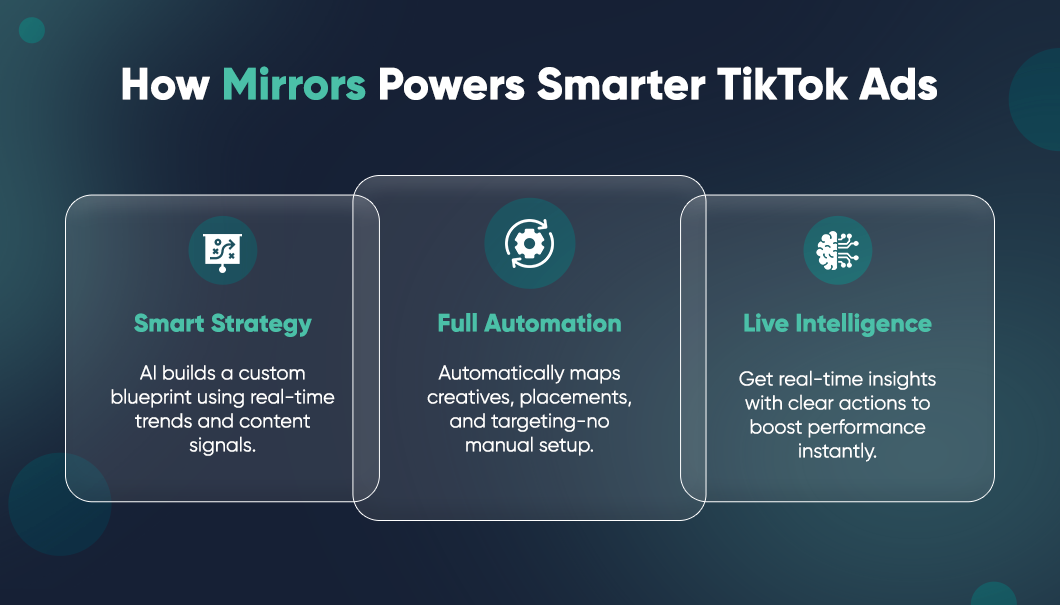
It’s not just another tool to place ads. It’s an AI-powered, all-in-one solution that helps you launch smarter, stay safer, and actually connect with people, instead of just reaching them. Think of it as your TikTok co-pilot: scanning what’s trending, deciding where your brand fits best, and keeping things optimized in real-time.
Because in short-form, blink-and-you-miss-it environments, context isn’t optional. It’s everything.
So, What Makes Mirrors for TikTok Different?
At its core, Mirrors is designed to help you stop guessing and start growing—faster and more confidently. It’s built on a three-layer AI engine that simplifies every step of your TikTok ad campaign:
Built-In Brand Safety That Keeps Up With TikTok Speed
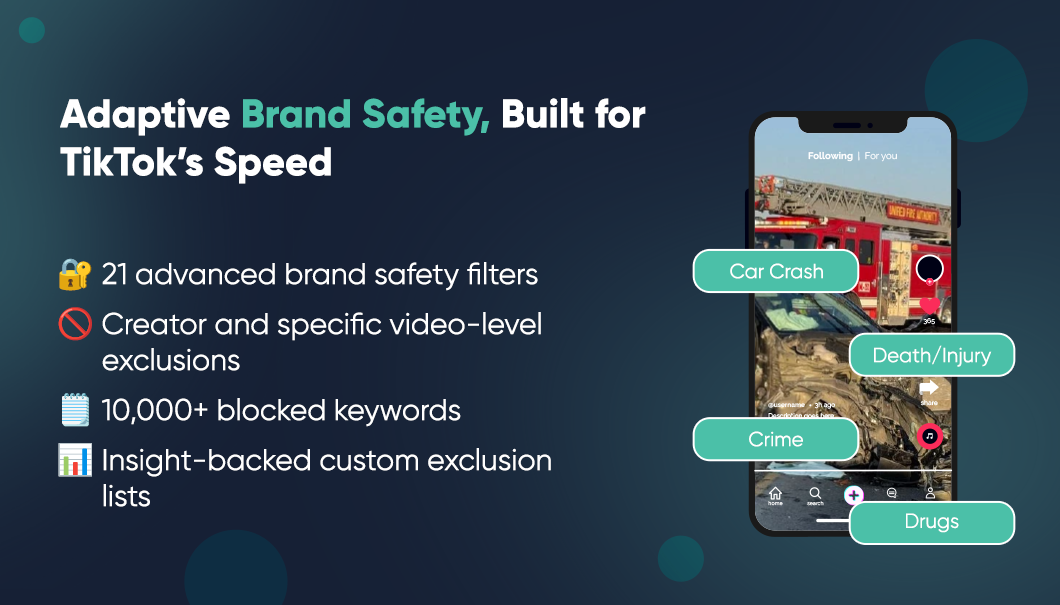
It’s the ever-shifting content feed that makes TikTok exciting, but also risky. With content shifting by the second, Mirrors adds an extra layer of protection that goes further than TikTok’s default tools. From advanced filters to video-level controls, your ads stay away from unsafe or off-brand content.
Why Now? Why Context?
TikTok doesn’t wait. New sounds, new formats, new creators—everything evolves overnight. To keep up, your targeting has to evolve too.
Contextual AI gives you the flexibility and precision you need to adapt in real time. It helps you stay relevant without needing personal data, which also checks the box for privacy-conscious users and brands.
And with 2025’s advertising landscape putting more weight on relevance, safety, and privacy, contextual targeting isn’t just a nice-to-have. It’s your edge.
Ready to Win TikTok in 2025?
If you’ve been struggling with limited targeting, poor brand alignment, or underwhelming campaign results, it’s time to try something different.
With Mirrors for TikTok, your brand doesn’t just show up—it fits in.
This is how you stop chasing trends and start riding them.
Contact us to see how smarter targeting can drive better outcomes.
Silverpush Partner Spotlight: Scott Stewart, EVP, Managing Director
PUBLISH DATE: 02 June 2025
This week, Silverpush is excited to feature Scott Stewart, the EVP, Managing Director at Epitaph Group. We break down what makes the agency special, why Epitaph Group chose Silverpush as a contextual partner, and, best of all, Scott’s hot take on the advertising world today.
1. Tell us about your agency. What makes you stand out?
I think the thing that is special about Epitaph Group is that we are a Canadian independent agency with very big ambitions. We have a portfolio of global, North American, and national clients. As a result, we’ve developed a proprietary product suite that has been designed to help vault us into becoming the agency of tomorrow – today!
As an agency, we recently went through a re-positioning around the whole concept of “Media Done Right”, largely to address some of what we see as the key issues affecting the industry. We want to position ourselves on the right side of history to do what’s best for our clients.
A commitment to better strategy, radical transparency in business, and an unwavering accountability to our clients’ best interest is what really sets us apart from other agencies and the holding companies, a lot of which have simply become principal buyers.
In short, being independent allows us to think independently.
2. What made you choose Silverpush as a contextual partner?
We are big believers in the attention economy and identifying partners that will help us increase the overall quality of what we buy on behalf of our clients.
Aside from brand safety, if we can increase quality by both buying better audiences and increasing ad attention, we are doing something right. Silverpush has been a key partner in helping us do that on YouTube, which continues to be a priority platform for our clients.
3. Has the market changed recently? What are the biggest trends that you’ve seen with clients recently?
Attention and accountability to ad spend are two key areas that we are focused on to help improve our clients’ investment, and contextual targeting has become a big part of that.
We see return on ad spending measurement as table stakes, which is why we have invested substantially in infrastructure for the agency to model and measure the performance of our ad buys.
At Epitaph Group, we see our jobs today as providing our clients with a clear and visible linkage between media dollars spent and business transactions created. We leverage this data to move away from having media conversations to having business conversations with our clients and outcome-based planning.
4. What ad channels are driving the best results?
It obviously depends on what the strategic objective is, but for long-term growth and brand building, video in general tends to be key for building awareness. In the short term, social is key, largely due to its cost efficiency and virality.
Now that we are doing a lot of measurement, specifically around attribution and incrementality, we can now quantify the impact of each channel on the bottom line.
That said, time and time again, we continue to see YouTube as a priority channel.
5. Have you noticed the impact of AI over the past year? Where have you seen it being used the most?
Machine learning has impacted our business model from how we use predictive AI from both a performance perspective, scoring incrementality, and obviously in what we are doing with contextual targeting.
ChatGPT has created a reduction in search and web visits, but the biggest area I think we have seen an impact in is deep research.
6. What are the biggest ad challenges for brands? What are the biggest opportunities?
The biggest challenge is another year of doing more with less from a budget perspective, how to leverage all this data, and how much of the budget should be dedicated to the brand.
The biggest opportunity is all based on building a model to understand incrementality and spending impact when it comes to the brand.
7. What is your advertising hot take?
Recently, we have seen the third wave of the rise of the creative indy here in Canada, with big creative names leaving the big agencies, only to open their own shops and achieve a great deal of success.
As more and more clients want better from their media agency, and by that, I mean better consumer insights, better strategic thinking, and better, more meaningful connections with their audiences, there is a big need for better media thinking.
Performance media has been the great equalizer, and true efficiency isn’t about how cheap you can buy anymore. It’s about the strategy, the solution, and how close you can get to the consumer.
Simply put: clients deserve better than they are getting from the industry, and that’s why we exist.
Want to learn more about Epitaph Group? Visit the agency website here.
Back-to-School 2025 Guide: Target Smarter, Advertise Better
PUBLISH DATE: 30 May 2025
Back-to-school shopping has gone fully digital, and it’s showing no signs of slowing down. In 2025, U.S. back-to-school spending is projected to hit $41.5 billion, with families spending around $253 per child. Despite tighter wallets, parents are still prioritizing essentials, and they’re finding inspiration and deals online.
However, this surge comes with a twist: while shoppers are spending more, according to the 2024 survey by Deloitte, 71% say they plan to cut back on nonessentials. So even with rising totals, the fight for attention (and conversion) is tougher than ever.
That’s where smarter back-to-school advertising makes the difference.
From early sales and e-commerce expansion to growing shopper stress, brands are entering a crowded, emotionally charged season. And in a moment shaped by both pressure and possibility, marketing needs to meet people where they are.
If your brand wants to stand out this year, the answer isn’t just bigger budgets. It’s a better context.
In this guide, we’ll break down what’s shaping back-to-school marketing in 2025, how shopper behavior is evolving, and how contextual targeting can help you show up when it matters most.

Get Ahead of the Class — Plan Your Best Back-to-School Ads
The 2025 Back-to-School Market Landscape
As the season heats up, so does the competition. This year, B2S advertising is being shaped by a mix of high demand, economic pressure, and evolving shopper habits.
Spending may be up, but shoppers are more cautious. Over 70% of parents are prioritizing discounts, second-hand finds, and flexible payment options. From sales and supplies to full wardrobes and electronics, value is everything.
What’s changing fast is how and where people shop. Back-to-school retail is now fully omnichannel. Parents expect a smooth, connected experience whether they’re browsing in-store, buying online, or doing both. And they’re starting early, often before July ends.
Retailers are responding with earlier back-to-school sales, AI-powered personalization, and new tools like AR-assisted shopping and gamified promotions. Tech is helping brands stay ahead—but only if they use it right.
Globally, we’re seeing this play out too. In the UK, AI-enhanced learning tools are trending. In France, BTS supply sales topped €330M. And across Europe, Gen Z alone spent over €16B last year.
Who Are Today’s Back-to-School Shoppers?
Back-to-school shoppers in 2025 aren’t just scanning shelves—they’re scrolling, swiping, and shopping with intent. From Gen Z students to Millennial parents, each audience brings different motivations and digital habits into the mix.
Take Gen Z: they’re not just buying notebooks; they’re watching creator hauls, saving TikToks, and choosing products that reflect their identity. College students, meanwhile, are driving categories like electronics, health & wellness, and dorm décor. And millennials? They’re shopping for both their kids and themselves, often with value, function, and convenience in mind.
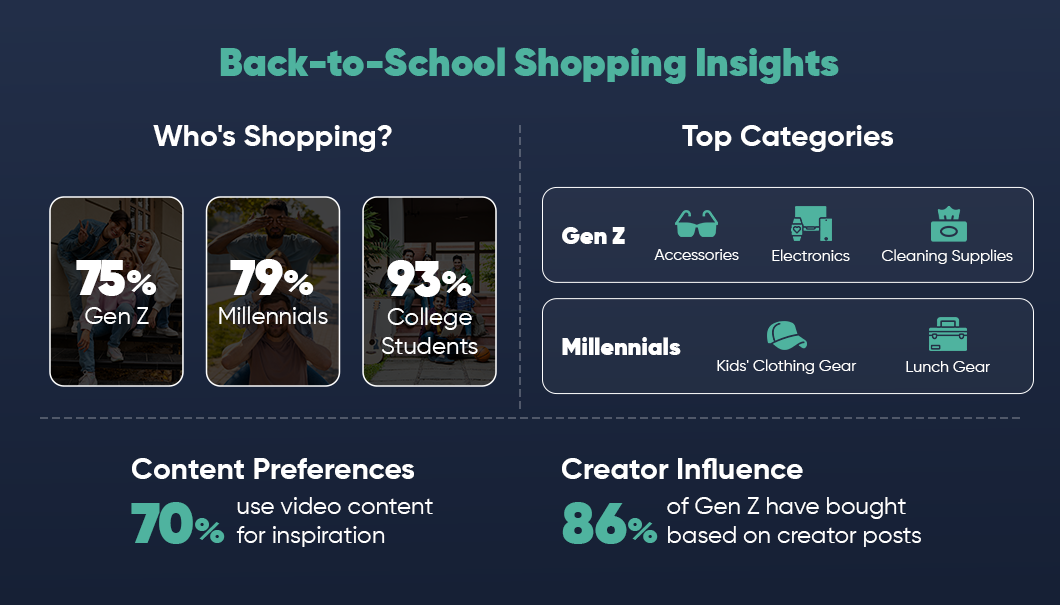
So what does this mean for marketers? You’re no longer selling to just a “parent” or a “student”—you’re engaging dynamic, creator-influenced, budget-conscious buyers who expect relevance at every step. To stand out, your back-to-school marketing must be as personalized and purposeful as the shoppers you’re trying to reach.
Why Context Is Crucial in Back-to-School 2025
With shoppers making quicker decisions and digital shelves more crowded than ever, relevance is the new reach. During back-to-school season, you’re not just competing for clicks; you’re competing for timing, mood, and moment.
Most shoppers don’t have time to scroll endlessly. In fact, 96% say they want products and promotions to be easy to find. That’s where contextual targeting shines. Instead of relying on cookies or assumptions, it places your ads next to content your audience is already engaging with—think BTS hauls, teacher tips, or college dorm setups.
The impact? Contextual ads can drive up to a 417% ROI uplift, especially when tied to real-time behaviors across YouTube, TikTok, and retail platforms. With 72% of consumers using social media to discover school-related content, it’s not just about showing up—it’s about showing up where and when it matters most.
As shoppers hunt for deals, ideas, and inspiration, your back-to-school marketing has to meet them in their moment, not after it. Context makes that possible.
How Silverpush AI Powers Smarter Back-to-School Campaigns
Smarter Back-to-School Campaigns with Silverpush AI
If timing is everything, Mirrors by Silverpush makes sure you never miss the moment.
Built for an omnichannel world, Mirrors by Silverpush is a contextual intelligence engine that helps you reach back-to-school shoppers right when they’re planning, scrolling, or shopping across YouTube, Shorts, social platforms, and programmatic media.
Instead of relying on guesswork or outdated signals, Mirrors uses a triple-layered AI model to scan real-time context, like parenting content, school supply hauls, or dorm room DIYs, ensuring your ads land where they’re most relevant.
It’s privacy-safe, cookie-free, and designed to unlock new audiences, new inventory, and stronger campaign performance when it matters most.
Back-to-school is no longer just a season—it’s a $41.5B moment of digital intent. Want to see how contextual targeting can help your brand own it?
Silverpush Partner Spotlight: Vaughn Ericson, SVP Activation Strategy
PUBLISH DATE: 21 May 2025
This week, Silverpush is excited to feature Vaughn Ericson, the SVP of Activation Strategy for True Media. We caught up with Vaughn about what makes True Media special and discussed the biggest trends in the ad market this year.
Here’s what Vaughn said.
1. Tell us about your agency. What makes True Media special?
True Media is an independent media agency helping leading and emerging brands across North America rise above the noise and make relevant connections with their customers. We work closely with our clients to apply deep media expertise and a genuine human perspective to enable them to find what’s true and elevate their brands.
2. What made you choose Silverpush as a contextual partner?
At True Media, we’re always on the lookout for innovative media partners. Silverpush brings smart processes and tech to the table to help us get the most out of our clients’ media dollars. Some might call them vendors, but to us, they’re true partners. They’re part of our team, working right alongside us with one shared goal: delivering industry-leading solutions and top-notch results.
3. How has the ad market changed over the past five years? Are there trends in your region that you’ve noticed specifically?
- The growth of video options, primarily CTV/streaming, has had a big impact on the market.
- Short-form video and the influencer economy have opened a new channel for marketers and consumers.
- The proliferation of AI technology across several areas (machine learning, content generation, contextual identification) has changed the way we do marketing.
- A new focus on Performance Media and measurable results.
- Growth of retail media networks and advertising opportunities within and outside of their walls.
I don’t think any of these are specific to our region. These trends have had an impact regionally, nationally, and globally.
4. What ad channels are driving the best results for clients right now?
There’s not a single channel that is driving the best results on its own.
At True Media, we’re focused on overall campaign goals and making sure that our integrated media plans are helping our clients rise above the noise and clutter to make relevant connections with their customers/target audiences. Although every channel and tactic must be tracked, optimized, and measured individually, we’re focused most on how each is contributing to the holistic campaign goals.
5. Are you noticing any specific trends in how brands are leveraging data or AI-driven tools to connect with local audiences?
While programmatic advertising and RTB have been driven by AI for years, advances in AI technologies let brands connect with customers in more hyper-targeted, hyper-personalized ways based on a variety of behavior, contextual, and/or location data.
6. What are the biggest advertising challenges for brands today? What are the biggest opportunities?
That’s a great question. The biggest challenges ARE the biggest opportunities.
Wrangling data. Using data effectively to reach the right target with the right message at the right time. It’s not a new concept, but a more complicated reality. Being data-driven while being efficient and effective with the data is critical. As stewards of our clients’ media dollars, reaching our target audiences with minimal waste and maximum results is our goal.
Want to learn more about True Media? Visit the agency website here.
Why Gen Z is Changing the Way Brands Approach Pride Month Advertising
PUBLISH DATE: 19 May 2025
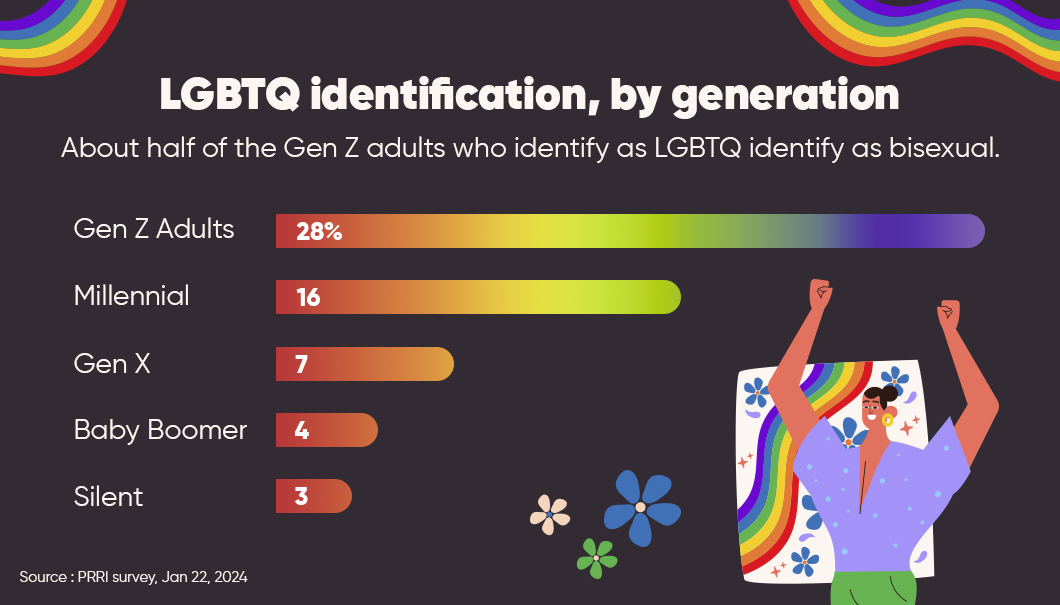
Nearly 1 in 4 Gen Z adults in the U.S. identify as LGBTQ.
That’s more than double the rate of Millennials, and it’s changing the way brands approach Pride advertising.
This isn’t just a stat. It’s a wake-up call.
Gen Z is the most diverse, values-driven generation we’ve seen. And with $3.1 trillion in global spending power, they’re not just making their own choices; they’re influencing how their friends, families, and even workplaces interact with brands.
So when Pride Month rolls around, they’re not looking for rainbow logos and feel-good slogans. They want real support. They want to see inclusion in your products, your people, and your platform, not just your June campaign.
For Gen Z, allyship isn’t a seasonal post. It’s a year-round expectation, and they’re not afraid to call out brands that don’t walk the talk. But they’ll also go all in on the ones that do.
So if you’re planning a Pride campaign in 2025, it’s time to go deeper. Here’s what Gen Z actually expects, and how your brand can show up in a way that feels real.
What Drives Gen Z to Buy During Pride (and Beyond)
But what does support actually look like to them, and how does it impact buying decisions?
Gen Z doesn’t just buy products; they buy into what your brand stands for. And during Pride, that matters more than ever. This generation is quick to spot rainbow-washing—when brands show up for the LGBTQ+ community in June, only to disappear the rest of the year. For Gen Z, real allyship means showing consistent support, not just putting up a rainbow logo once a year. They expect authenticity backed by action.
In fact, according to the McKinsey Report 2024, around 70% of Gen Z actively seek out ethical brands, and they’re not afraid to dig into a company’s track record, looking at donations, partnerships, and internal policies before making a purchase. If your values don’t line up with your marketing, they’ll notice and move on.
Representation also plays a big role. About 80% want brands to be inclusive and diverse, and more than half want to see that reflected in leadership too. For them, inclusion isn’t a marketing angle, it’s the standard. This is a generation that sees gender and identity through a wider lens. Over a third (37%) believe gender exists on a spectrum, and 23% prefer being asked for their pronouns rather than having assumptions made.
They also live and shop on social media, with more than 50% having bought something they saw on a platform. So if you’re working with LGBTQ+ creators in authentic ways, you’re already on the right track.
Ultimately, Gen Z rewards brands that are consistent, inclusive, and community-focused—not just during Pride Month, but every day of the year.
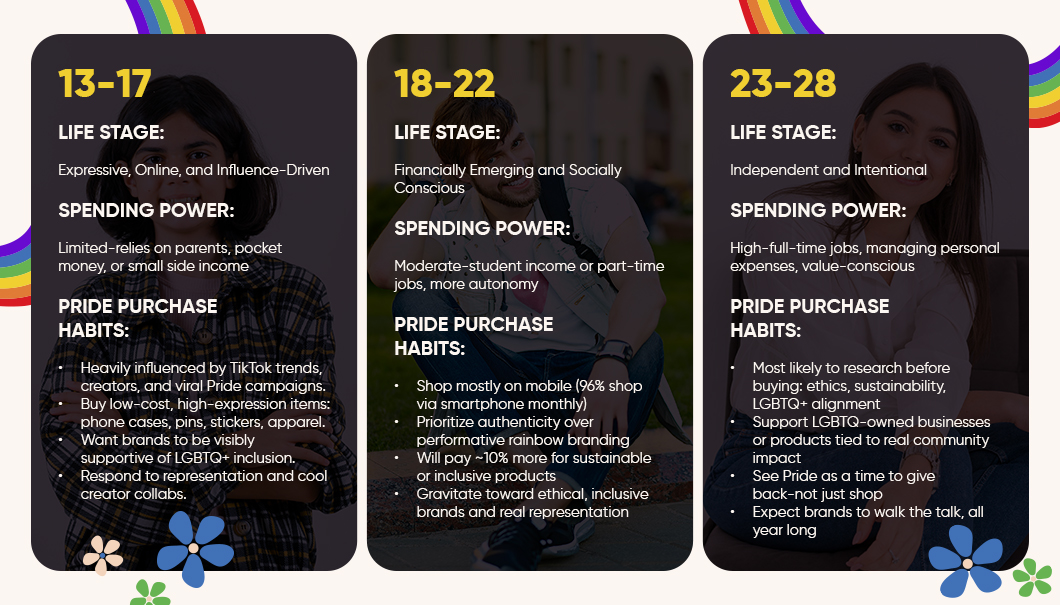
Gen Z Pride Shopping Behaviours by Age
Gen Z (ages 13 to 28 in 2025) isn’t one homogenous group. Their Pride-related purchase behavior is shaped by age, income, digital habits, and how they express identity. Here’s how their motivations break down by life stage.
Where to Reach, and Really Engage—Gen Z During Pride 2025
Once you understand what Gen Z expects from brands during Pride, the next step is knowing where to reach them and how to make that connection meaningful.
This generation spends a huge amount of time on platforms like YouTube, TikTok, and Connected TV. But they’re not just watching passively. They’re choosing what to engage with, and they’re paying attention. In fact, research by Precise TV and Giraffe Insights shows that six in 10 Gen Z teens opt to watch YouTube ads rather than skip them, and nearly half can recall the ads they’ve seen. That’s a major opportunity for brands, but only if your content feels relevant, timely, and native to the platform.That’s where Silverpush’s Mirrors solution comes in. Mirrors uses AI-powered contextual intelligence to analyze video content in real time and place your ads in the moments that matter most—like Pride-themed content, LGBTQ+ creators, or inclusive conversations—Gen Z is already watching. With no cookies or invasive tracking, it ensures your message appears in the right context and aligns with what this generation cares about.
But showing up is only half the battle. To truly connect with Gen Z, you need to move beyond passive impressions and create opportunities for interaction. That’s where Crafters, Silverpush’s creative intelligence solution, makes a real impact. It lets you turn regular video ads into interactive experiences—think swipeable stories, tap-to-explore product reveals, or clickable elements that make ads feel personal. And with 38% of Gen Z preferring personalized ads, nearly double the rate of Millennials, it’s a smart way to meet their expectations.
At the end of the day, Gen Z doesn’t just want to see your Pride message. They want to engage with it. And when you meet them on the platforms they love, with content that feels both authentic and interactive, you’re not just reaching them—you’re building real brand connection.
